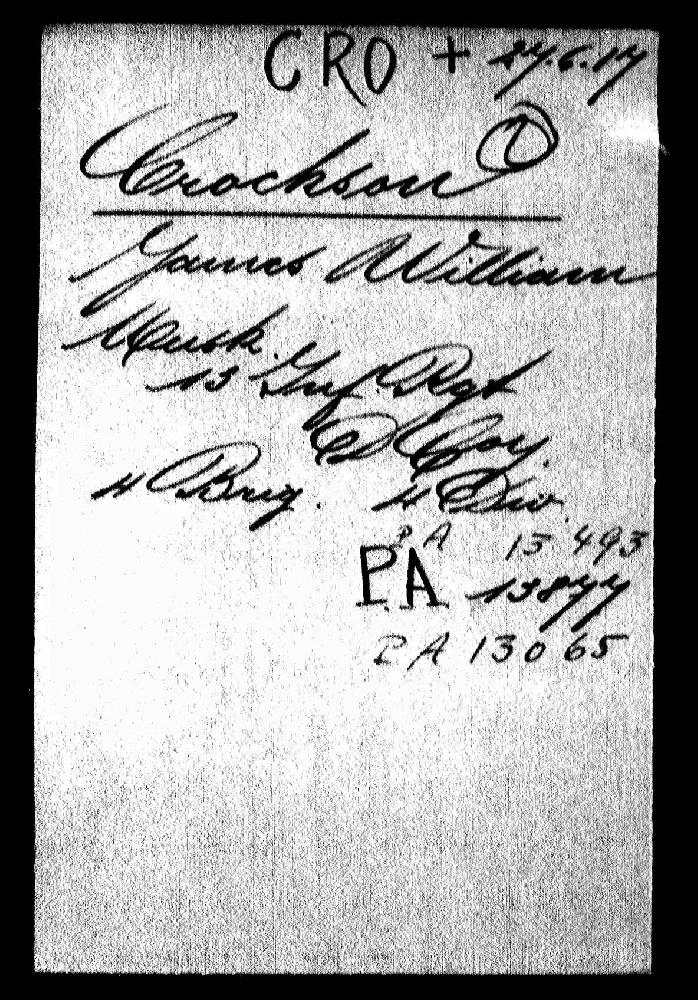
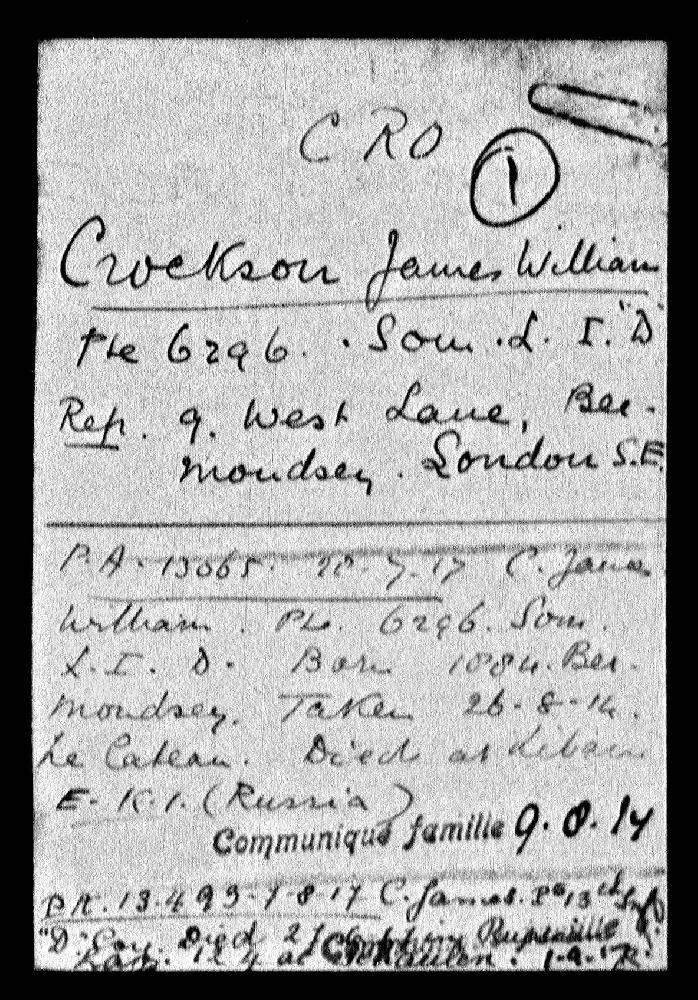
James William Crockson : 4th June 1884 to 27th June 1917

- Regiment : 1st Somerset Light Infantry
- Service # : 6296
- Rank : Private
An overview of the short life of James Crockson.
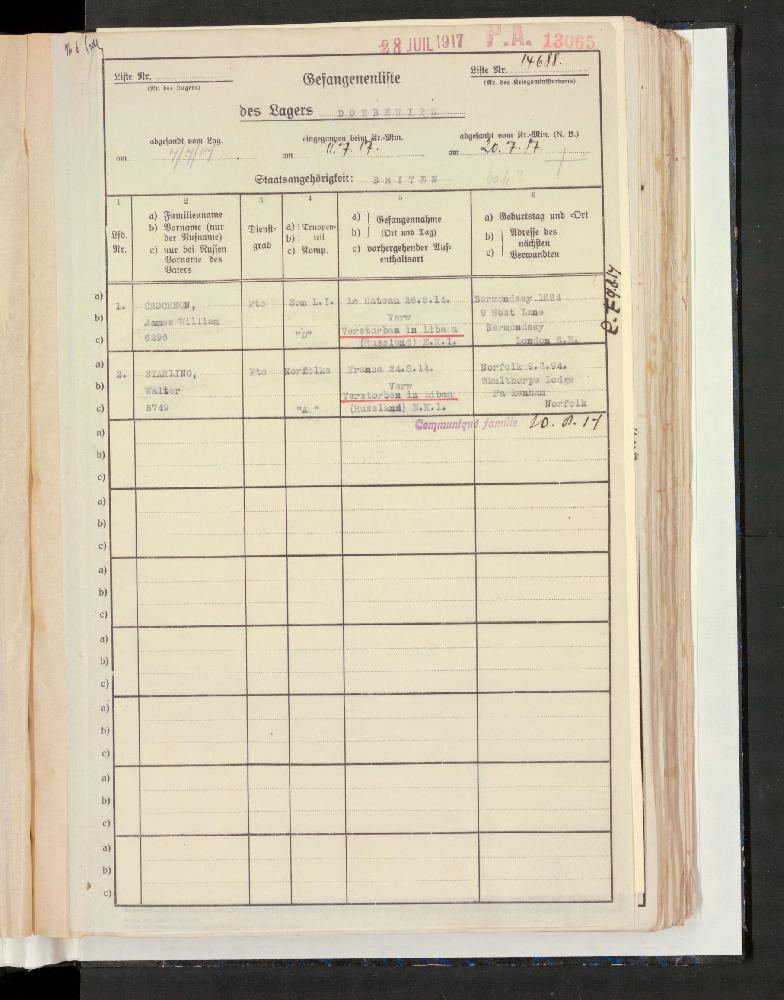
James Crockson was born on 4th June 1884 in the St. Olave district of Bermondsey and was married to Ellen M O'Connor in 1913 in the same district, which is now located within the London Borough of Southwark in London.
Not much is known about James' life prior to his enlistment into military service and there is very little information about his time in the 1st Somerset Light Infantry, with whom he saw active service. However, it can be assumed he was involved with the Infantry's first movements on 17th August 1914 when they first moved from Colchester and then their recorded campaigns later that month before he was captured on 26th August 1914 at the Battle of Le Cateau.
Memorial Inscription : WHO DIED AS A PRISONER OF WAR AND WAS BURIED IN SZAWLI CEMETERY BUT WHOSE GRAVE IS NOW LOST - THEIR GLORY SHALL NOT BE BLOTTED OUT
Please click on the year tabs to
open up events for that period.
James Crockson : A timeline
1884
June 4th
St. Olave, Bermondsey, London (Birth)
James William Crockson was born(#1) in the district of St. Olave, Bermondsey, now an area within the London Borough of Southwark.
REFERENCE & FURTHER READING :
1913
Exact date unknown.
St. Olave, Southwark (Marriage)
James married (#1) Ellen M O'Connor who was born 1889. The wedding took place in the district of St. Olave, Southwark, London, England.
After James died in 1917, Ellen appears to have remarried (#2) a William Barber in 1923 and died (#3) as Ellen M Barber in 1960.
REFERENCE & FURTHER READING :
1914
August 17th
Colchester to Harrow (Regiment Relocated)
The 1st Somerset Light Infantry, along with the 11th Infantry Brigade, departed Colchester Barracks in order to relocate for Harrow where other divisions had already begun to muster from other areas.
Once arrived, the Battalion camped on an incline within the playing fields of Harrow School.
Over the following 3 days, field training and route marching continued on from where it had been previously ceased at Colchester.
August 21st
Harrow to Southampton (Regiment Relocated)
At 7pm, The Somerset Light Infantry departed Harrow by train and arrived at Southampton at around 11:30pm.
August 22nd
Southampton, England to Le Havre, France (Embarkation and Transport)
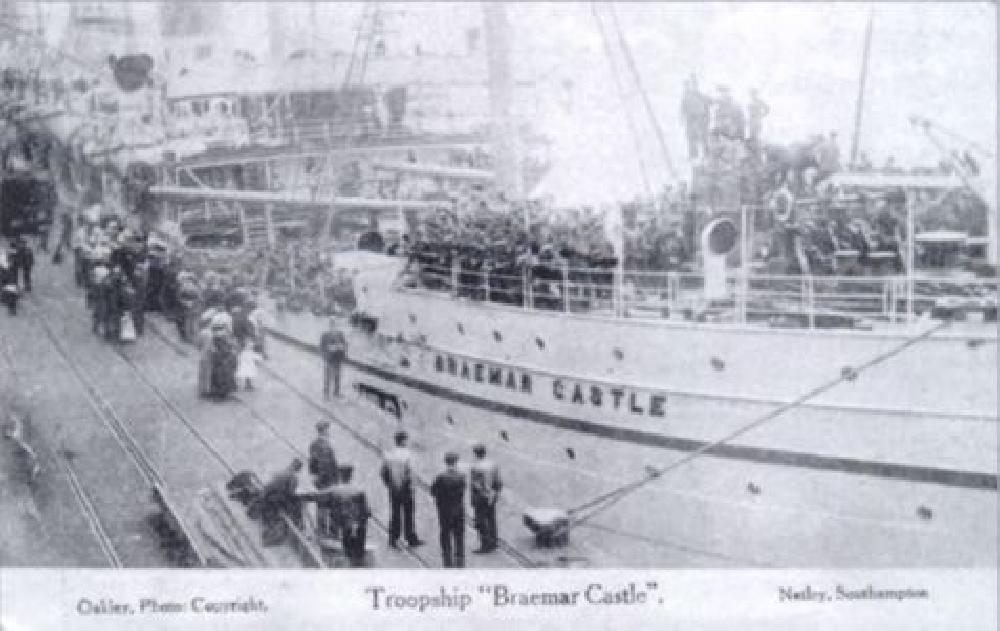
S.S. Braemar Castle (circa 1914) :
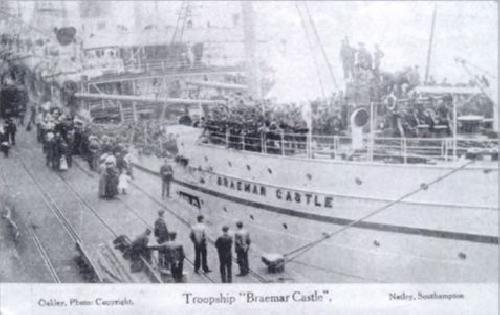
At between midnight and 1.00am, the Somersets embarked onto the ship, S.S. Braemar Castle and departed Southampton for France (Le Havre) at around 8.30am. The ship was reported as passing the Isle of Wight at approximately 11.00.am.
Conditions on board were described as cramped, with officers sharing three to a cabin. A breakfast of 'Bully beef and biscuit'#1 was available, as well as lunch.
The conditions for the crossing was reported by a soldier on board as being 'smooth' seas and the weather as 'excellent'.
At 7.00pm, the ship received the French Pilot for Le Havre, but was unable to dock due to low tides, with the pilot making many failed attempts.
The ship finally disembarked at Le Havre between 11.30pm and 00.30am and the regiments on board finally arrived at the 'Rest Camp' at around 4am.
REFERENCE & FURTHER READING :
August 23rd
France (Rest Camp)
Images related to the time James Crockson left Le Harve , arrived and the rest camp and awaited transportation to posting in field.
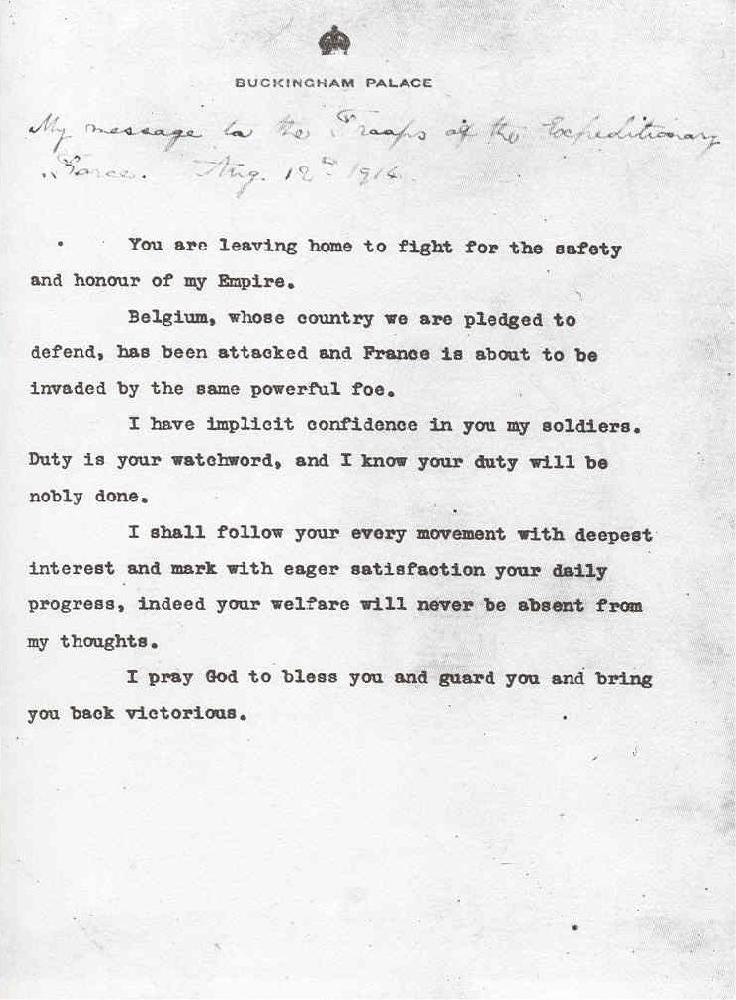
The Kings Message :
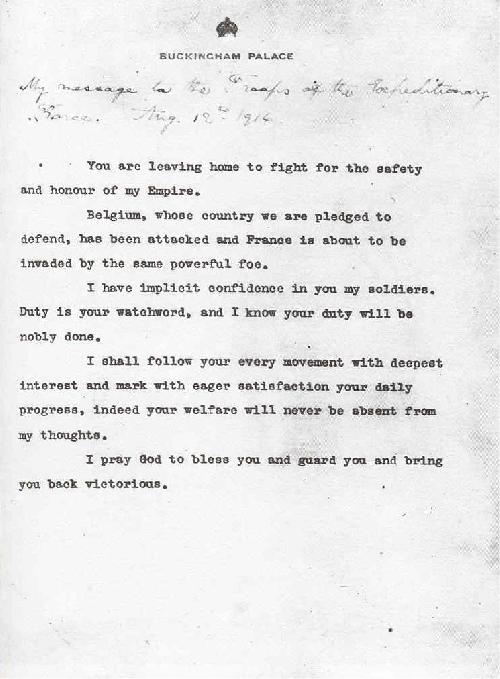 This message was read to the army by the commanding officer at the first opportunity after embarkation, to parade his unit.
At approximately 2.00am, marched for from Le Harve to get to the rest camp location about 6 miles away. This took around 2.5 hours, mainly marching uphill on what was recorded as a hot August night.
During the day at the camp, the amalgamated Battalions had some rest and undertook numerous camp duties.
At 8.00 pm the Battalions were called to parade and the Colonel read to them the King's message and were told that they would very soon be fighting the enemy. Two hours later they arrived at the railway station where horses, equipment and vehicles were loaded onto wagons by men on fatigue duties. While this was taking place, many of those that were not on duty slept on station platforms etc.
NOTES :
WAR OFFICE INSTRUCTION 61 (1914) :
The accompanying gracious message has been received from His Majesty the King for communication to the army after embarkation for active service. General Officers Commanding should give instructions to the following effect:
The Officer Commanding each unit will take the first opportunity, after embarkation, to parade his unit. He will bring it to attention and read aloud the King’s Message and then call for three cheers to His Majesty.
KING'S MESSAGE TRANSCRIPT :
9 August 1914
Buckingham Palace
You are leaving home to fight for the honour and safety of my Empire.
Belgium, whose country we are pledged to defend, has been attacked and France is about to be invaded by the same powerful foe.
I have implicit confidence in you my soldiers. Duty is your watchword, and I know your duty will be nobly done.
I shall follow your movement with deepest interest and mark with eager satisfaction your daily progress; indeed your welfare will never be absent from my thoughts.
I pray God to bless you and guard you and bring you back victorious.
George RI
August 24th
Le Cateau (Day 1)
At 02:00am, the Somerset Light Infantry departed Havre Station and for the best part of the next fifteen hours were travelling to Le Cateau. During the very uncomfortable and hot journey, the train stopped at Rouen, where coffee and a small nip of Brandy were offered.
The troops were finally detrained at 5.00pm with new orders given to go to head to the village of Briastre and occupy outposts to the north.
While the above was occurring, the German front-line had managed to gain some foothold in the area. It was initially thought by the troops that they were positioned about 200 miles away, but were in fact new reports coming in while the Battalion was deploying itself, suggest that were in fact less than five miles away and should be prepared for enemy engagement at any second.
The 4th Division (of which the 1st Somerset Light Infantrys were a part) were not fully assembled and very unprepared as the supporting troops of cavalry, engineers, artillery and ammunition had not yet arrived to the area.
August 25th
Le Cateau / Solemes / Viesly, France (Day 2)
At 4.00 am, at very short notice, the Division were order to march to the village of Solesmes and occupy positions to the South.
Later that evening, heavy firing was heard nearby and it was decided to start withdrawing the area. By 5.00pm, vehicles had been withdrawn.
At around 6.00pm, German cavalry were spotted nearby and random shelling started. At around 9.00pm, the Division troops were ordered to withdraw and in several formations, removed from the area by 11.00pm, with new positions taken up to the South of the Viesly area.
August 26th
Le Cateau (Day 3)
1917
June 27th
Schaulen (Russia) (Death)
Images related to death in burial of James Crockson.
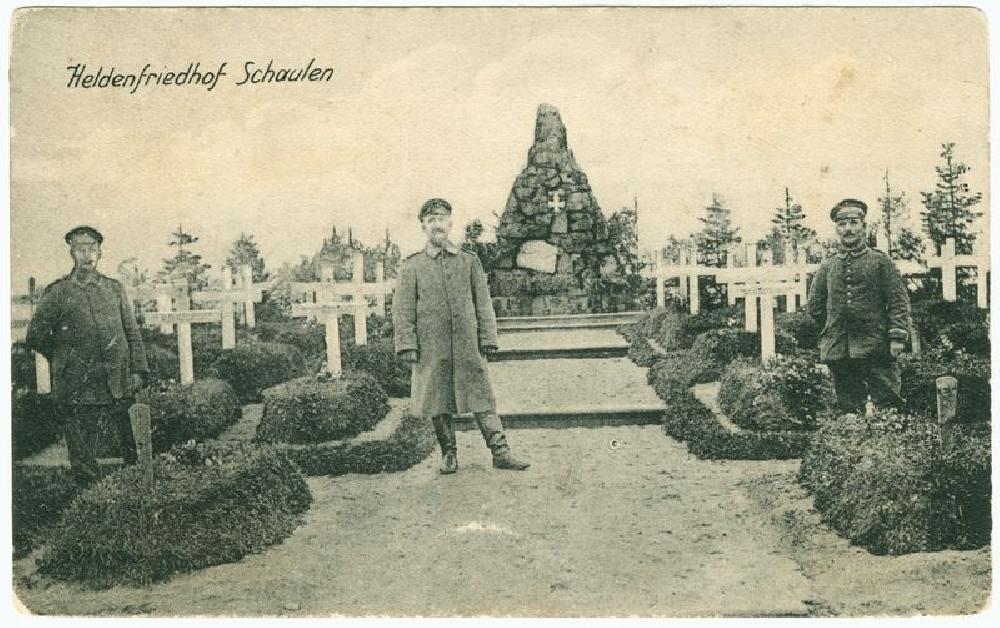
The German War Cemetery in Schaulen :
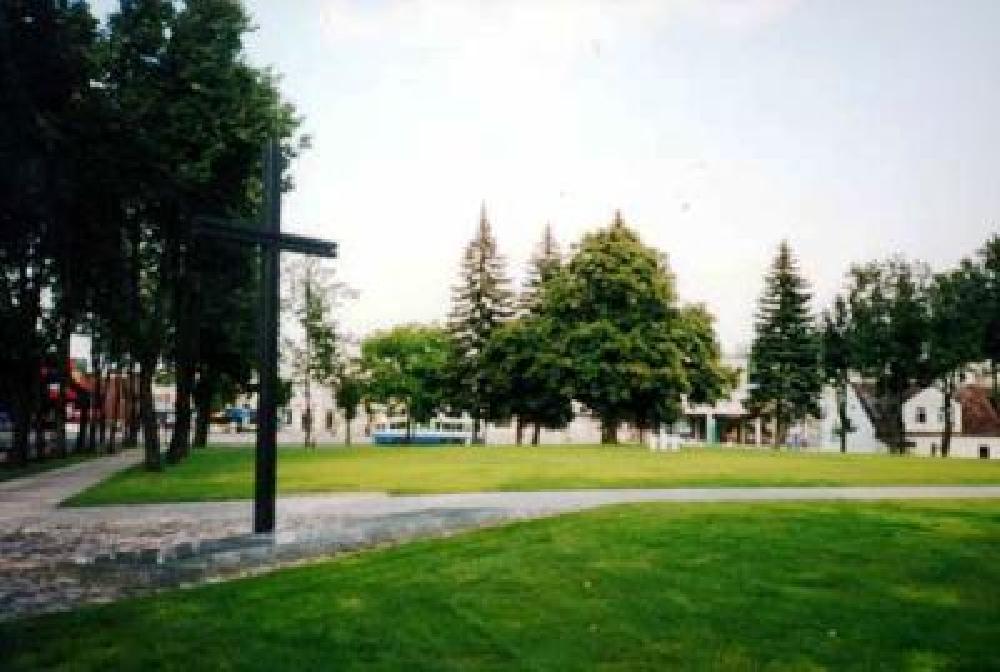
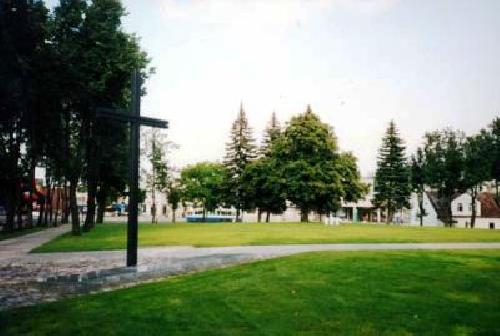 The German War Cemetery in what is now Siauliai, Lithuania.
Schaulen Cemetery (circa 1917) :
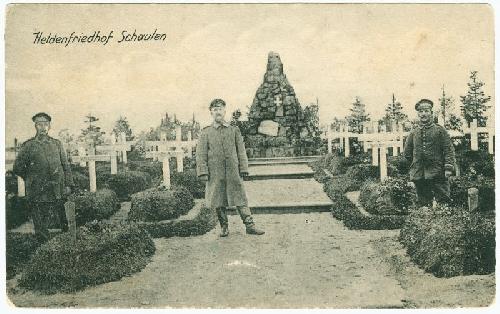
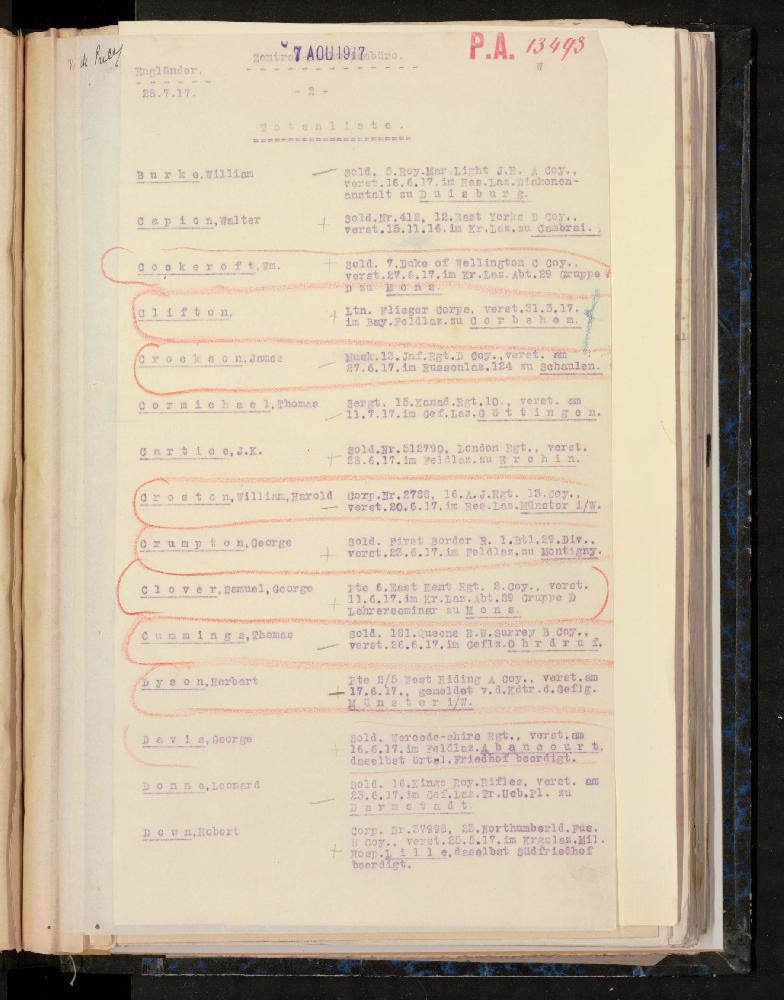
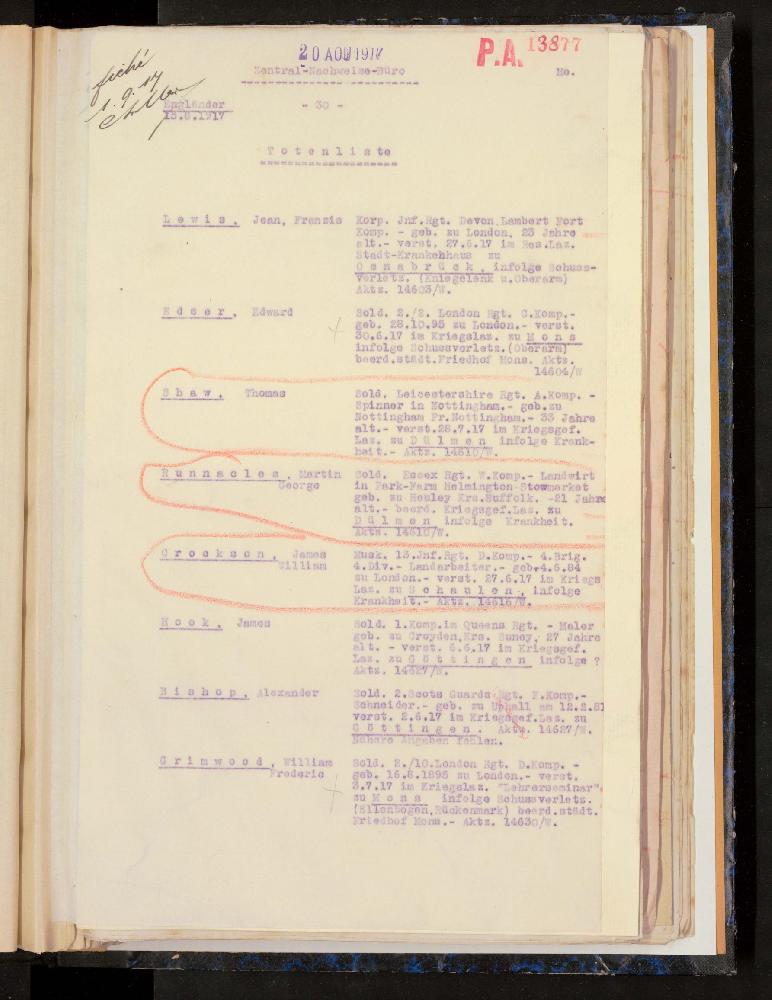
James died on 27th June 1917 and was buried in what was then the Szawli (Schaulen) German Cemetery in Russia (now Šiauliai within the Republic of Lithuania).
NOTES :
Although James' memorial is located at Old Vites Cemetery (#1) in Klaipeda, he is actually buried at the Schaulen German Cemetery in what is now Siauliai in the Republic of Lithuania. His exact burial spot is unknown; hence the memorial in Klaipeda.
REFERENCE & FURTHER READING :